n4ze3m · 17 October 2026
On 21 July 1969, while Armstrong and Aldrin were on the Moon, the Soviet probe Luna 15 tried to land in Mare Crisium and crashed. Jodrell Bank was listening. In 2009 it released an edited recording from its control room. Jodrell's staff followed the probe's Doppler shift live in 1969 and reported the crash at the time. This page measures the probe's signal on the released tape. I couldn't find a published measurement of it.
In short:
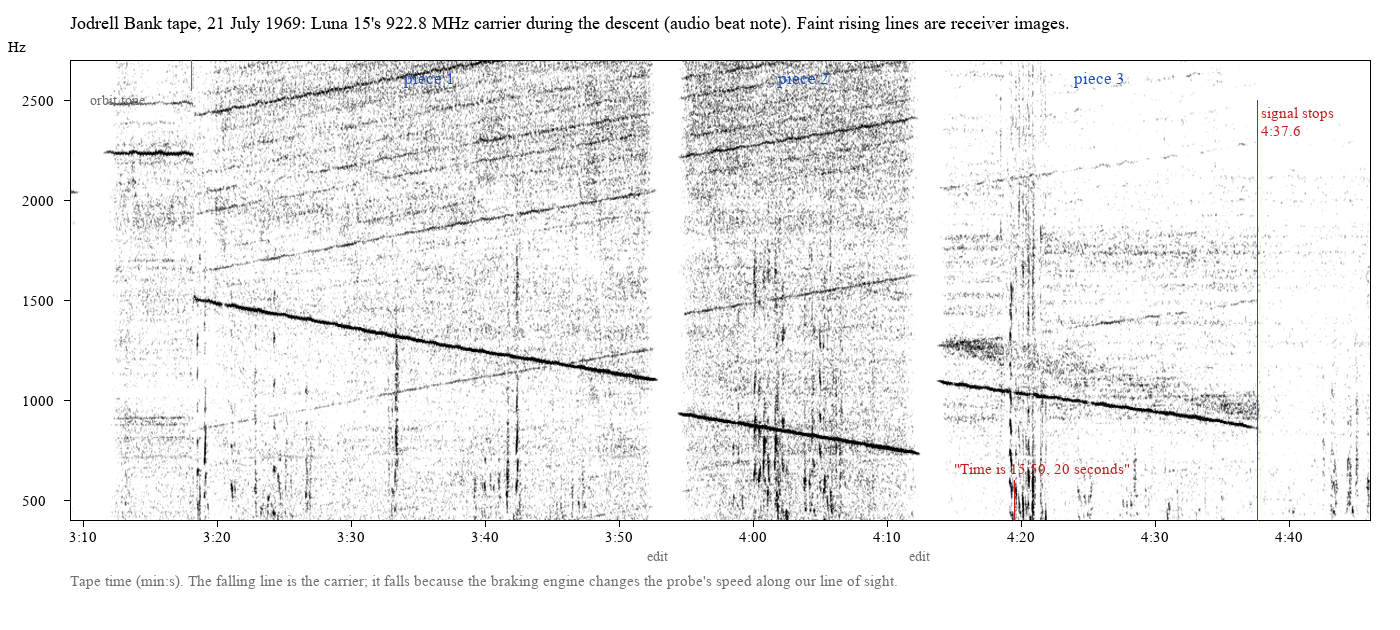
Made from Jodrell Bank's recording. Darker means stronger. The falling line is Luna 15's carrier.
Contents:
The recording is "The Luna 15 and Apollo 11 tapes", released by Jodrell Bank in July 2009: jb.man.ac.uk/multimedia/audio/luna15-apollo11.html. It is an edited extract (5 min 35 s) of control-room tapes from 19–21 July 1969, with Bernard Lovell narrating. The audio is © Jodrell Bank Centre for Astrophysics and is not copied here. Please listen to it there.
The quotes are from my machine transcription (Whisper) and may contain errors; the time check at 4:18 is worth hearing for yourself.
These facts are other people's work. This page only measures the tape against them.
What I could not find anywhere: measurements of the signal on the released tape, the timing from the tape's own clock call, or the band described in section 6. I searched English and Russian sources, X, Hacker News, YouTube, Reddit, GitHub and Google Scholar on 17 October 2026.
The tone is the 922.8 MHz carrier, mixed down to an audio note by Jodrell's receiver. When the probe's speed toward Earth changes, the note moves. The rate of change in Hz per second, times the wavelength (0.325 m), is the probe's acceleration along the line of sight. I tracked the note through each piece and fitted a smooth curve:
| Piece | Tape | Note | Falls by (Hz/s) | Braking along the line of sight (m/s²) |
|---|---|---|---|---|
| 1 | 3:18.4–3:52.9 | 1506 → 1102 Hz | 12.5 → 10.0 | 4.0 → 3.2 |
| 2 | 3:54.6–4:12.5 | 931 → 732 Hz | 10.7 → 11.4 | 3.5 → 3.7 |
| 3 | 4:13.8–4:37.4 | 1093 → 863 Hz | 10.7 → 9.0 → 12.1 | 3.5 → 2.9 → 3.9 |
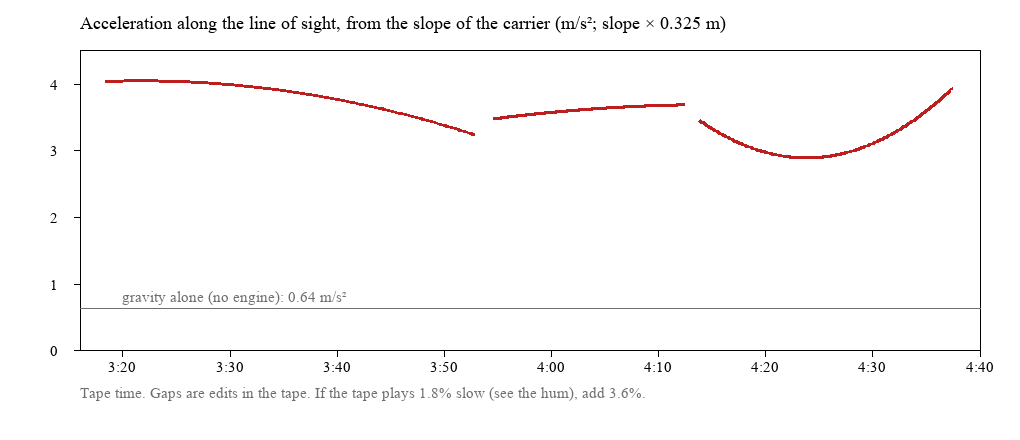
The Earth stood about 23–26° above the horizon at the crash site. A probe falling freely there would change its speed toward Earth at only 0.64 m/s². The tape shows four to six times that throughout, so the engine was firing in all three pieces. The note jumps up between pieces 2 and 3, which braking alone would not do, so the receiver was most likely retuned during that edit. Because the edits removed an unknown amount of time, pieces 1 and 2 can't be placed exactly within the 237 s burn.
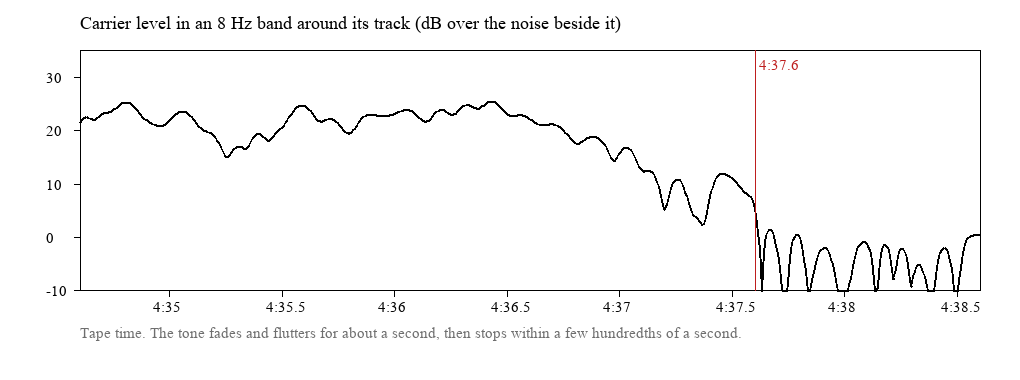
The note is strong until about 4:36.7. It then fades by 15–20 dB, fluttering, and disappears at tape 4:37.594, within a few hundredths of a second. Up to that moment it is still falling at 12 Hz/s, about 4 m/s² of braking, so the engine was firing when the signal stopped. This is not an edit. A steady 98 Hz hum on the tape runs straight through that instant with its phase and level unchanged, while the hum jumps at the real edits.
At tape 4:18.4–4:20.6 a voice reads the clock: "Time is 15:50, 20 seconds". The signal stops 17.0–19.2 s of tape later. That puts the end at about 15:50:37–39 UT; if the tape runs 1.8% slow (section 7), it moves about 0.3 s earlier. The Soviet record gives contact lost at 15:50:40. Just after the end, the staff on the tape settle on "42", i.e. 15:50:42. The clock call must be in UT: the burn began at 15:46 UT, and Lovell's later remark, "the time now is ... 15:57", only fits UT.
With the carrier shifted to 0 Hz, the last piece shows something the first two don't. It is a faint, smeared band 40–300 Hz above the carrier, with nothing like it below. It moves with the carrier and ends at the same moment.
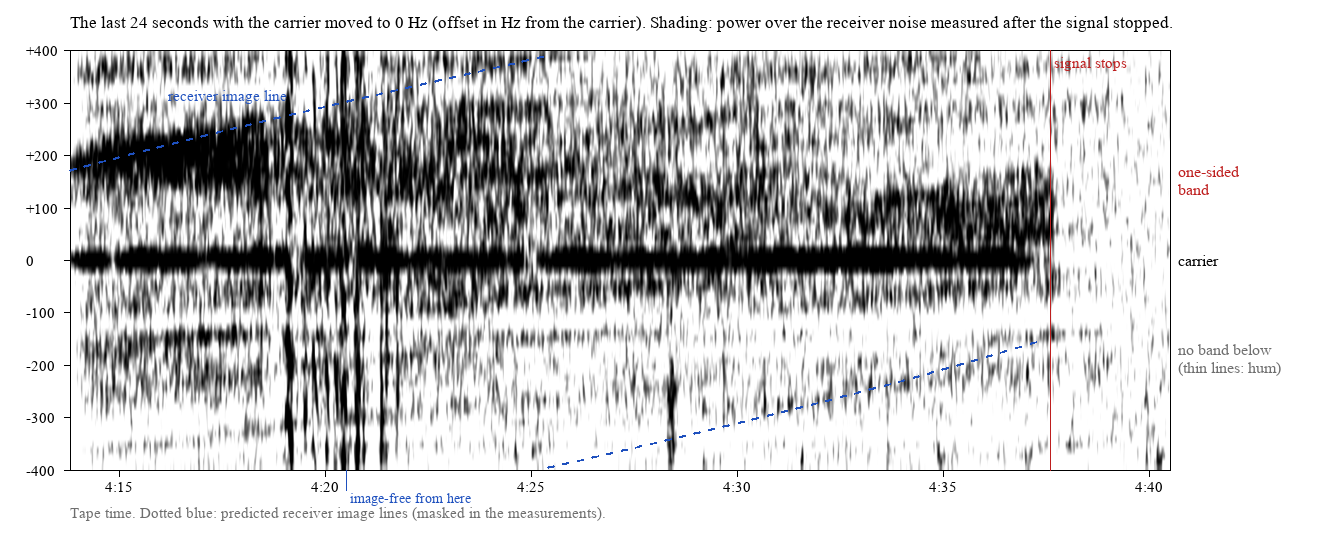
The faint rising lines are images made by the receiver (section 8); they are masked in the measurements.
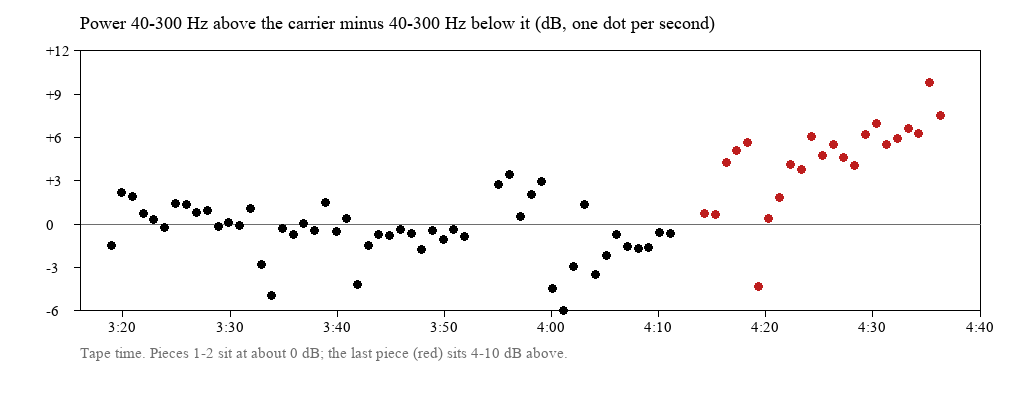
Why an echo. Spacecraft signals reflected by the lunar surface are well known; Apollo 14 and 15 used them on purpose as "bistatic radar". In 2024 Daniel Estévez saw spread-out reflections like this in JAXA's SLIM lander signal as it came down. He notes that for flat ground the reflection's shift is set by twice the vertical speed. When a probe descends, its mirror image in the ground moves up, toward Earth, so the reflection arrives shifted up relative to the direct signal. That is the side the band is on. The audio is not flipped. The in-orbit tone earlier on the tape drifts down, as it should for Luna 15's retrograde orbit seen from Earth.
What it would mean. With the Earth 23–26° up, every 100 Hz of shift is 37–41 m/s of closing speed toward a flat reflecting surface. The band then says the probe was closing on the ground at roughly 65–73 m/s at 4:21, slowing to about 32–35 m/s when the signal stopped. That is a controlled descent, not a plunge. It fits the Soviet account of a probe still braking on its planned path, about 3 km up, when it struck high ground. This is the most speculative part of the page.
But this is an interpretation. Uneven sidebands from engine vibration, or an effect in the 1969 receiver, could also make a one-sided band. I can't rule them out from one edited tape.
Every number on this page comes from one script run on the MP3 from Jodrell Bank. The code, data and figures are also on GitHub: github.com/n4ze3m/luna15.
python luna15.py Luna15-Apollo11.mp3 out/.Corrections are welcome. GitHub · n4ze3m.com · @n4ze3m